Tag: robin griggs wood

  • My Second Research Term For The Arcanum: Chromatic Aberration. Why? It’s Annoying…

    My Second Research Term For The Arcanum: Chromatic Aberration. Why? It’s Annoying…

    SAMSUNG CAMERA PICTURES

    So if you read my post My First Research Term For The Arcanum: Silence. Why? It’s Complicated…, you’d know what this is all about. As Robin Griggs Wood’s apprentice in Trey Ratcliff’s Arcanum, part of each week’s challenge is to research a term that relates to creativity. While the first term I researched was silence, this time, I chose “chromatic aberration.” Whether you know what it is or not, you’ve seen it, you’ve experienced it, and it’s annoyed the living crap out of you, so here’s a basic breakdown of the bugger and what I’ve found.What Exactly Is Chromatic Aberration?

    So this is one that has usually just meant nothing more to me than “those annoying purple or green fringes I get on high contrast edges in some of my pictures, especially when the sun is involved.” I knew it had something to do with the lens, something to do with the light angle, and something to do with, well, sciency stuff, so figured this was a perfect opportunity and reason to find out once and for all what chromatic aberration is and how and why it’s caused (and if there’s anything I can do to avoid it).

    The science: Wikipedia puts it like this: “Chromatic aberration (CA, also called achromatism, chromatic distortion, and spherochromatism) is a type of distortion in which there is a failure of a lens to focus all colors to the same convergence point. It occurs because lenses have different refractive indices for different wavelengths of light (the dispersion of the lens). The refractive index decreases with increasing wavelength.”

    Well, duh! I could have told you that (yeah right…).
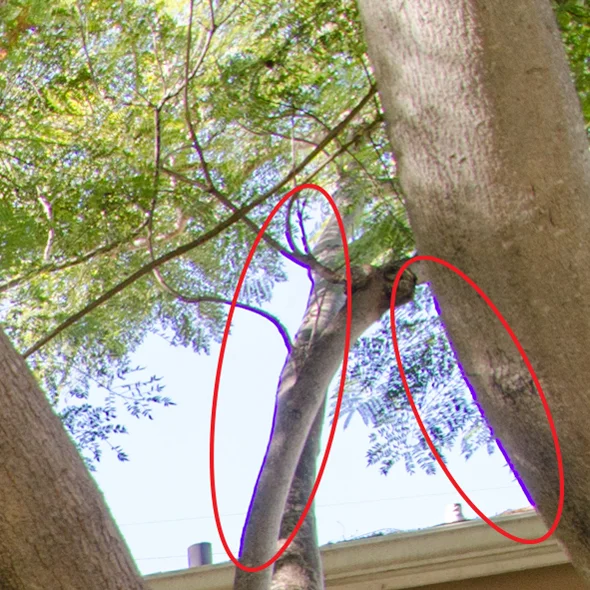
    Wasim-Muklashy-Photography_Purple-Fringing_chromatic-aberration_with-fringe-circled

    Wasim-Muklashy-Photography_Purple-Fringing_chromatic-aberration_nofringe

    My next destination was a link that leads to a Georgia State University Physics page that explained how blue light wavelengths are shorter than red light wavelengths, and since focal length depends on a phenomena called refraction, which is “the bending of a wave when it enters a medium where its speed is different,” the index for refraction blue and red lights are different.

    So now that the smart people terms are out in the open, I needed it explained in layman’s terms, so I did a bit more digging and I found this at PhotographyLife.com:
    “Chromatic Aberration, also known as ‘color fringing’ or ‘purple fringing,’ is a common optical problem that occurs when a lens is either unable to bring all wavelengths of color to the same focal plane, and/or when wavelengths of color are focused at different positions in the focal plane. Chromatic aberration is caused by lens dispersion, with different colors of light travelling at different speeds while passing through a lens. As a result, the image can look blurred or noticeable colored edges (red, green, blue, yellow, purple, magenta) can appear around objects, especially in high-contrast situations.

    A perfect lens would focus all wavelengths into a single focal point, where the best focus with the “circle of least confusion” is located.”

    Aha. And that actually helps it become a bit clearer and more approachable.

    So what it sounds like is that it happens when all of the colors of the spectrum can’t make it to their intended finish line at the time the shutter is pressed. Whether it be actual physical limitations, or limitations based in physics and the ways wavelengths move and work, the stars are just unable to align due to factors including exposure settings, positioning of the lens, and how much glass the waves have to penetrate in order to reach the sensor.

    Essentially, because of the way that light works and how each color has it’s own distinctive wavelength, in order for them to be accurately represented, they need to be in the same place at the same time, and when you’re taking a photo and each of these wavelengths of color has to travel through different, it makes it very difficult for them to reach the same point at exactly the same time. So some of them are left on the fringes. They ‘re not usually very apparent, but when you’re dealing with high-contrast edges, it’s easier to see them because of those hard edges. Almost the same way it’s easier to see the immediate difference between black and white versus a gradient that moves from black to white gradually. Imagine an image that was half black and half white, if you put a gray line separating them, it’d be extremely apparent on that hard edge. Now, imagine an image that was a gradual gradient from black to white, and you put a grey line somewhere in between, it’d be a bit harder to pick it out because it’s lost in a gradient of grey – there’s a lot of grey area in between. That’s essentially what’s happening. Some of the wavelengths are getting caught in between the point of origin and the destination – your sensor, like on the black/white card.

    Now that I have a clearer idea of what’s happening, I was curious if there was a way to avoid it, and apparently there isn’t. At the moment, science and physics trumps the human mind’s capacity to solve this one. That same PhotographyLife.com link explains that “This kind of…chromatic aberration is present even on high-end, expensive lenses like the Nikon 35mm f/1.4G.”

    Luckily for us, we do have a go around, one I’ve been using for quite some time, and one that apparently I’ll continue to have to use, at least for now. Lightroom has a chromatic aberration correction tool in the ‘Lens Correction’ tab on the ‘Develop’ pane. You click it, and then there are sliders for green and purple that you can slide to determine the color range of chromatic aberration to remove, and, wallah! It’s gone!

    In this case at least, software trumps physics…

    For more of my madness:
    Instagram: @wasimofnazareth
    Ello: @wasimofnazareth
    Google+: www.Google.com/+WasimMuklashy
  • My First Research Term For The Arcanum: Silence. Why? It’s Complicated…

    My First Research Term For The Arcanum: Silence. Why? It’s Complicated…

    Wasim Muklashy Photography_110114_Samsung NX30_Rocky Peak Park_Simi Valley_California_The Arcanum_Silence

    Part of the deal as an apprentice in The Arcanum is each week we are presented with a weekly challenge by our master, and with each weekly challenge, in addition to finding images based on a theme, we are to find a term that relates to creativity in some way (however broad is up to us) and research that term and what we found out about it. So while I was trying to think of what term I wanted to research for my first weekly challenge, I found myself navigating my way through the eternal Facebook stream of doom, looking for a post I saw earlier from a friend that I wanted to comment on, and all I could see are BE SCARED EBOLA OBAMA DEMOCRAPUBLICANS TERRORISM EBOLA LIBERAL HELL WRATH CONSERVATIVE RACIST FIRE DOOM DIE OH YEAH AND EBOLA when all I could think to myself was, ‘shut up already!’
    So, that was the birth of the term I wanted to research for my first weekly challenge in The Arcanum: Silence.

    Needless to say, I knew that silence had a much broader meaning than just the lack of noise, but I was completely surprised to see that in the official Wikipedia post about silence (let’s face it, Wikipedia is the new Encyclopedia Britannica – for those of you that remember that monstrosity…), the meaning of silence has broadened to accept:

    “total communication, in reference to nonverbal communication and spiritual connection.”

    Wow. Spiritual connection? Communication through silence?

    And not only that, but this:

    “…as a culture Westerners shy away from silence because it is fearful to be in quiet.”

    Wha? Why?

    “This instinct is created from our culture where mixed medias play constantly, emerging technologies force us to drop everything and respond and the daily life is polluted with noises all around us effecting our health.”

    And that’s just from the first few lines. And it was those first few lines that explained it all – the same week that an article came out saying that the first actual diagnosis of phone addiction has been made, and that techno-addiction is now an actual ‘thing.’

    It’s not that we don’t want the silence, we’re actually biologically afraid of it.

    And I can understand it. And I can more than understand exactly how the mass media plays on that fear. We literally wouldn’t know what to do with ourselves if every newscaster and ‘expert’ and ‘pundit’ and ‘respected personality’ one day just got on the air and said “Oh, there ain’t a darned thing going on today. It’s all good. We’re just going to chill.” Ironically, we’d freak out and wonder what was wrong rather than what they were telling us, that’s all’s right! We probably wouldn’t even allow ourselves a moment of silence to take it in.

    And apparently, and scientifically, that’s because we’re afraid. We’re literally afraid of what we might have to face if we weren’t constantly faced with madness and psychotica from all directions at all times. If we didn’t have distraction after distraction from distraction after distraction. The fact that things can actually be…all good. The crazy part is, things are better now than they ever have been in human history. There is actual quantifiable evidence showing less war, destruction, famine, and death today than at any time in human history.

    But we would never know it now would we?

    I couldn’t help but think, perhaps if we spent more time in silence, that reality might take hold.

    Process that: things are better now than they ever have been.

    So chill out y’allz…it’s all good.

    Now how does this have anything to do with photography or art or the Arcanum? I have no idea or real good answer for that. I suppose the best I could do is that I feel we should be paying just as much attention, if not more, to the good in life, than all the seemingly inescapable bad. It can, apparently, have profound impacts on our health, both physical and mental. And I can only imagine it could serve the impetus for some pretty incredibly beautiful art!

    Now let’s shut up and make stuff!

    For more of my madness, take your pick:
    Instagram: @wasimofnazareth
    Ello: @wasimofnazareth
    Google+: www.Google.com/+WasimMuklashy

  • Ello Ello Ello Ello – All Aboard! My First Week On The Thing

    Ello Ello Ello Ello – All Aboard! My First Week On The Thing

    Image asset

    So I’ve gone and done it…I’ve hitched a ride on the food cart of the Ello train to sample their wares. Here’s how our honeymoon together, our first week, has gone so far. A friend sent me an invite, I logged on, I created a profile (as quick and easy as a username and a short description), and immediately was like, WTF? But then I noticed an actual WTF button on the page. I knew we had a future together.

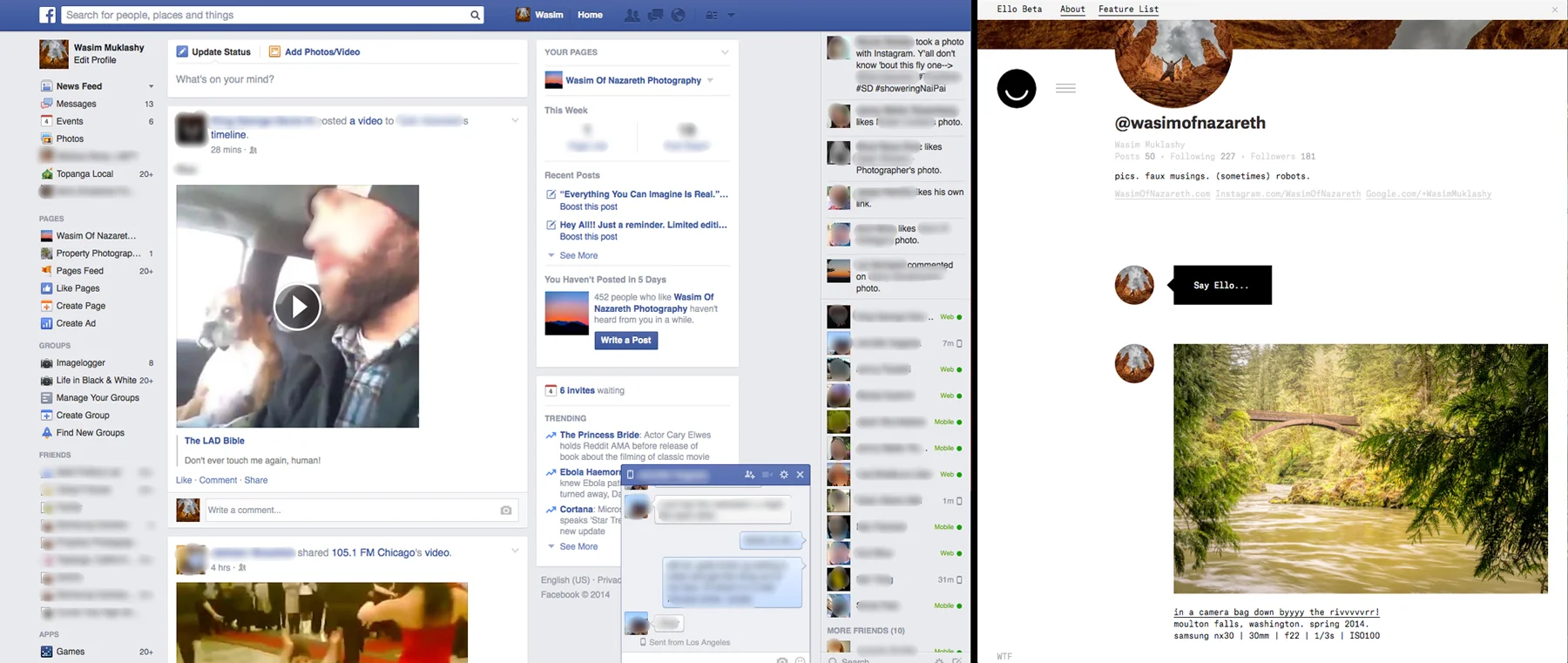
    Why? Well, Facebook has become, for lack of a better term, shit. I log on and all I see are sponsored posts, ads, games, and videos that, despite the fact that my psyche doesn’t give more than zero mehs about them, my eyes still can’t help but obsessively flicker and stutter. And every now and then, sprinkled very sparingly between those mehs, are perhaps a few posts from friends or family. And in those few posts, perhaps a non-political, non-religious, or non-narcissitic gem or two might stand out amongst the noise. Don’t get me wrong, I love my friends and family, and love seeing what they’re up to, but, well, it’s not all that easy to filter through the madness anymore. While taking screen grabs for this post, I literally scrolled through 11 posts before finally finding 2 – TWO – posts from someone I knew squashed between that casino floor. And this after hitting the useless ‘I don’t want to see this’ button EVERY TIME one of those posts rolls through for the past 3 months. I’ve deleted every ‘app,’ squashed every ‘game,’ to no avail.

    Enter Ello.

    facebook versus ello comparison image

    Simplicity lies at its raw, but tasty, core. And not a SINGLE ad surrounds that.

    Sure, there is extremely minimal functionality, which, between likes and shares and candy crush sagas and page feeds and random invites from sponsored posts (aka the equivalent of early 2000s pop-ups), might be a shock to the zombie robot humanoid system, but, once the withdrawal systems start to wane, you can’t help but realize how…wonderfully clutter-free…this thing is.

    One, posts are simple text (with a nice nostalgic typewriter font) – you can link, you can bold, you can italicize.

    Two, you can only organize contacts into ‘Friends’ and ‘Noise.’

    Three (my personal favorite), pictures look GREAT!!! No compression, no stripping of EXIF data, no renaming to some randomized Da Vinci Coded shlabberdasshery of numbers and letters.

    So yes…clean…clutter-free…simple.

    Hell, there isn’t even a ‘like’ button for posts. At first, my (un)natural reaction was, ‘oh snap, what do I do?” Then I realized…ohhhhh…right….communicate! I mean, let’s face it, for the most part, ‘likes’ are nothing more than a gratuitous nod to a stranger as you walk down the street. You don’t really give half a turd, it just seems the respectable thing to do. After all, half the time the person liking didn’t even see the post itself. For example, I’ll post a link to a video that’s 4 minutes long. Immediately I’ll get 5 likes. Within 30 seconds. Which means that either they only watched :30 seconds of the video or none of it at all. More often than not (call me jaded), I’m forced to assume the latter. (Hint to the obsessive likers – at minimum, wait until the length of the video passes before hitting that button…jus’ sayin’…)

    On Ello, this is impossible. Because you have to communicate and engage in order to get the best experience and have those dopamine neurons fire. So this ‘no like’ button thing that started off as the first thing to irk me, ended up being my favorite part of it. After all, because of it, within the first week, I somehow find myself communicating with ‘The’ Thomas Hawk, engaged with my celebrity Arcanum master Robin Griggs Wood, shared with and interacted with my fellow Samsung Imageloggers in a much more photography friendly environment, and have been exposed to a whole slew of new artists, creatives, and thinkers that may have never crossed my path otherwise.

    It seriously feels like everyone has just been waiting for something…anything…to help ween them off the Facebook nipple, and whether or not it lasts is anyone’s guess, but it’s already been worth it simply to have connected with new faces, once seemingly unapproachable faces, and ideas that were left simmering in the background before this platform forced them to ripen. Kinda like a cocktail party – feel each other out, and perhaps you’ll connect on deeper more meaningful levels on the periphery.

    What it has done, at least for the meantime, is refreshingly brought engagement back. It’s brought a proper human element back. Thoughtful, real, expressive communication.

    Sure, there are a few things that can be improved (like including a like-button equivalent on JUST comments – otherwise, acknowledging that you saw someone’s comment can quickly turn into an akward ‘Who’s got the last word’-fest), and no doubt as it becomes more popular, they will work on those things, but it’s nice to be a part of something in which the users have a say and impact on the output of what it turns into.

    And even if it just lasted this one week alone, that was good enough for me. Because the true implications lie in this encouraging bit:

    Despite all our techno-addictions, people still want and crave real connections with people.

    So, while this ain’t our first rodeo, and know it can very well all implode at any given moment, until then…get at me!

    www.ello.co/wasimofnazareth

    Ello Ello Ello Ello!

    For more of my madness:
    Instagram: @wasimofnazareth
    Google+: www.Google.com/+WasimMuklashy