Category: Interviews

  • Tiger Style! Wu-Tang Clan’s Shaolin Secrets Revealed In The Eight Diagrams

    Tiger Style! Wu-Tang Clan’s Shaolin Secrets Revealed In The Eight Diagrams

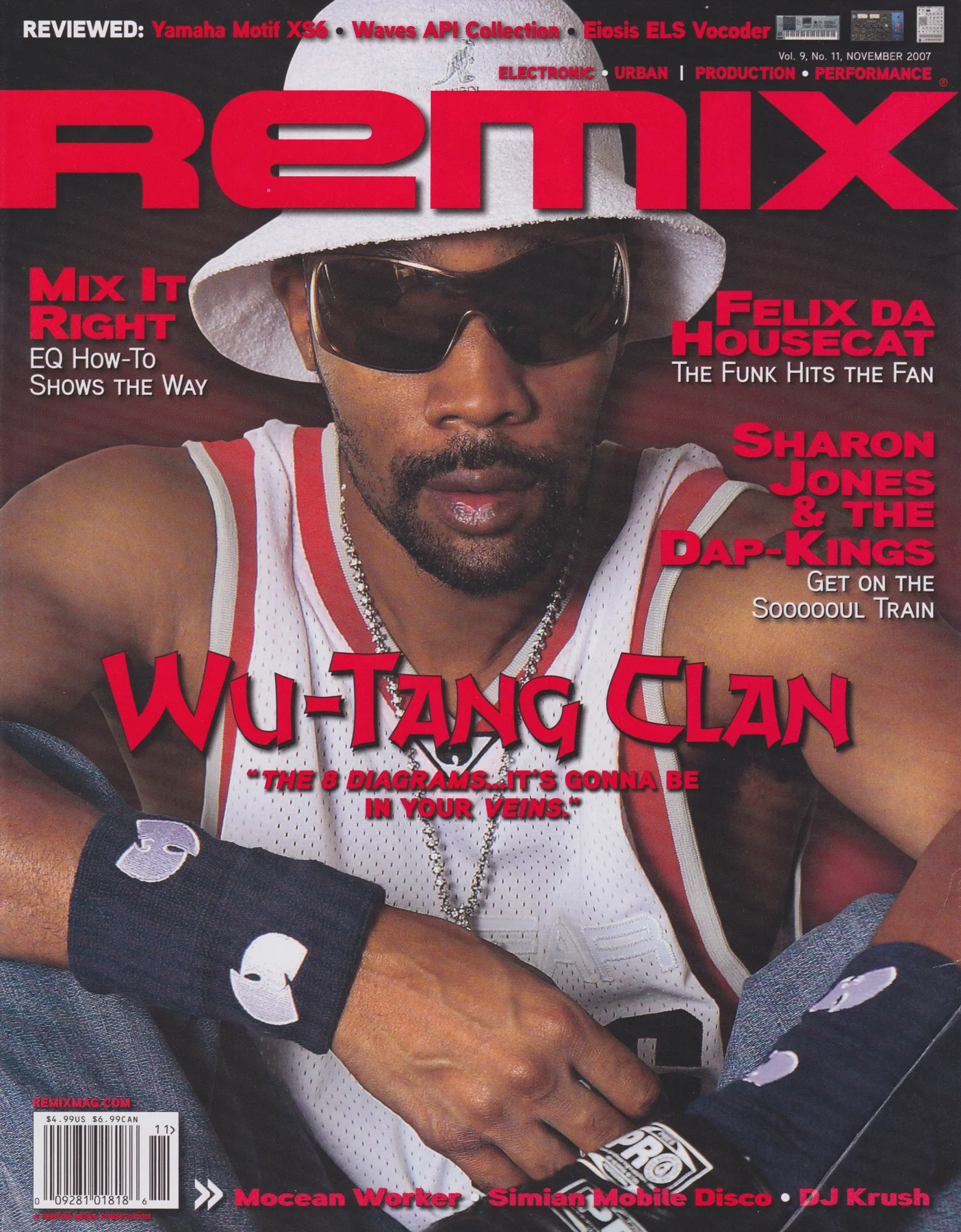
    Remix Magazine_Wu Tang Cover_Wasim Muklashy Article_The Eight Diagrams

    (Please note: This is from an interview with the Wu-Tang Clan from 2007 for Remix Magazine. While the magazine is no longer in business, this interview needed to exist! For all you old-schoolers, click here for a PDF of the printed article if you prefer.)

    “Let me tell y’all something! You’re gonna see a lot of emcees in your life! You’re gonna see a lot of hip-hop in your life! But don’t you never forget one thing motherfuckers! TIGER STYYYLLLEEEE!!!” -RZA Rocks the Bells in San Bernardino, CA on August 11, 2007

    Anyone growing up in this cursed generation ought to consider themselves awfully lucky. Yes, yes, you look at the news, you see the papers, you hear the polar bears cryin’, the Middle East bleeding, and the religious zealots choking on their own excrement, and it’s hard to immediately agree, but consider this…how many generations can rightfully claim being witness to the unlikely birth, the uncontrollably rapid rise, and the glorious apex of arguably the world’s most influential musical genre?

    While hip-hop was gaining credible steam in attempting to prove itself as more than just a ‘passing fad’ through the 80s, there was a clan of cats from the streets of Staten Island, NY who were honing their craft, paying each others’ bail, fine-tuning a style, dodging bullets, stealing electronic equipment, street hustlin’, and spiritually evolving all at the same time. They embraced the culture that they lived, immersed themselves in the movement, and locked themselves in a chamber. What they emerged with grabbed the music world by its horns, turned it upside down, and shook the shit out of it until any semblance of doubt fell forever from its pockets.

    Embraced by everyone from computer geeks to Australian pop rock bands to every ‘hood this side of the prime meridian, there is perhaps no other entity or individual in the past decade with such a strong and lasting influence on the genre, style, and culture that is hip-hop than the Wu Tang Clan. They exploded with a plan to take over the hip-hop world.

    A 5 year plan masterfully crafted by their de-facto ringleader Robert Diggs, aka RZA.

    A plan that worked.
    Remix-Magazine_Wu-Tang_2007-3

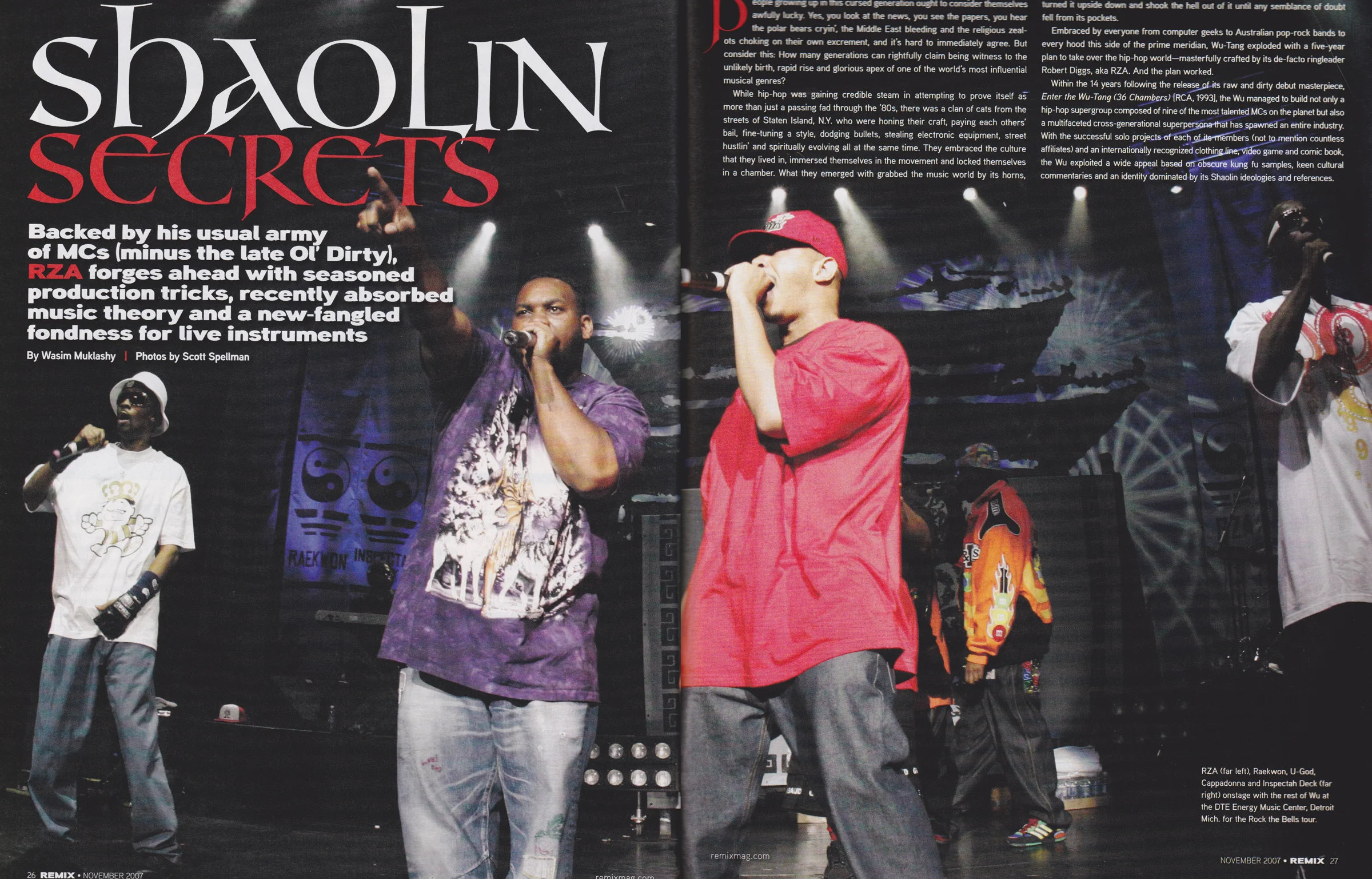
    Within the 14 years following the release of their raw and dirty debut masterpiece Enter The Wu-Tang (36 Chambers), they’ve managed to build not only a hip-hop super group comprised of 9 of the most talented MCs on the planet, but a multi-faceted cross-generational super-persona that has spawned an entire industry. Between the wildly successful solo projects of each of its 9 members (not to mention countless affiliates), an internationally recognized clothing line, video game, and comic book, all tastefully exploiting a wide appeal based on obscure Kung Fu samples, keen cultural commentaries, and an identity dominated by its eerie yet inspiring Shaolin ideologies and references, they’ve proven more than just another hip-hop group. The Wu created, and defined, a way of life, simply by holding a mirror up to their own.

    Following the 2004 death of one of its most unique and celebrated, albeit trouble-prone, members, Russell Jones, (aka Old Dirty Bastard, Unique Ason, Joe Bannanas, Dirt McGirt, Dirt Dog, Osirus, and, who could forget, Big Baby Jesus) a bit of the air was understandably taken out of them. But with a levelheadedness and insatiable appetite to evolve, RZA corralled the rest of the crew: GZA, U-God, Method Man, Masta Killa, Raekwon, Inspectah Deck, and even Ghostface Killah. He also enlisted master wordsmith and formerly honorary member Capadonna, as an official member. They refocused, realigned, and, thankfully, soldiered on.

    “It really just took a phone call and an explanation that ‘yo, it’s time for us to do our thing’ and everyone felt the same,” tells us RZA over a heaping plate of Thai spaghetti. “So I went up to New York myself, booked the studio, and started the process. We promised this to the people,” he iterates, “so now it’s time to deliver The Eight Diagrams. It’s gonna be in their veins.”

    In between records, and in the past several years, RZA has added to his arsenal both materialistically and spiritually. Inspectah Deck divulges that there are “well over 1000 Wu or Wu-affiliated songs,” a majority of which RZA has had a leading role in producing. It’s this tireless resume, along with numerous movie scores (among them Kill Bill Vol.1, Afro Samurai, and Ghost Dog : The Way of the Samurai), and an ever-increasing thirst for knowledge, that have played the biggest part in preparing for The Eight Diagrams.

    “What I did over these last 10 years, I picked up my first music book. I started studying music theory, and now I’ve got 10 years in. I know how to play piano on an intermediate level. I know how to play guitar on an intermediate level. Now I know that he went from C to F, he went to B-minor then he went to A-minor,” RZA prides.

    “Harmonic progression, that’s what I mostly studied. In hip-hop, you don’t need melody, because the voice and the rhymes are the melody, so you need harmony. I’ll share that with your audience. That’s a secret right there.”

    Another important aspect of RZA’s uniquely keen production prowess comes not from something he has learned, but something he was born with – an innate ability to trust his own insticts. “If you go listen, I may have a slight off-beatness to my music, and I realize, it’s me,” he tells us. “Forever may have been more quality than 36 Chambers, but it still never meet the quality of what Dr.Dre’s doing…I still never had that wide EQ produced quality. Not because I ain’t got an SSL (mixing board). I got the same SSL they got…the same big speakers, the same system. I just don’t hear it how they hear it. I hear it how I hear it.”
    Remix-Magazine_Wu-Tang_2007-4

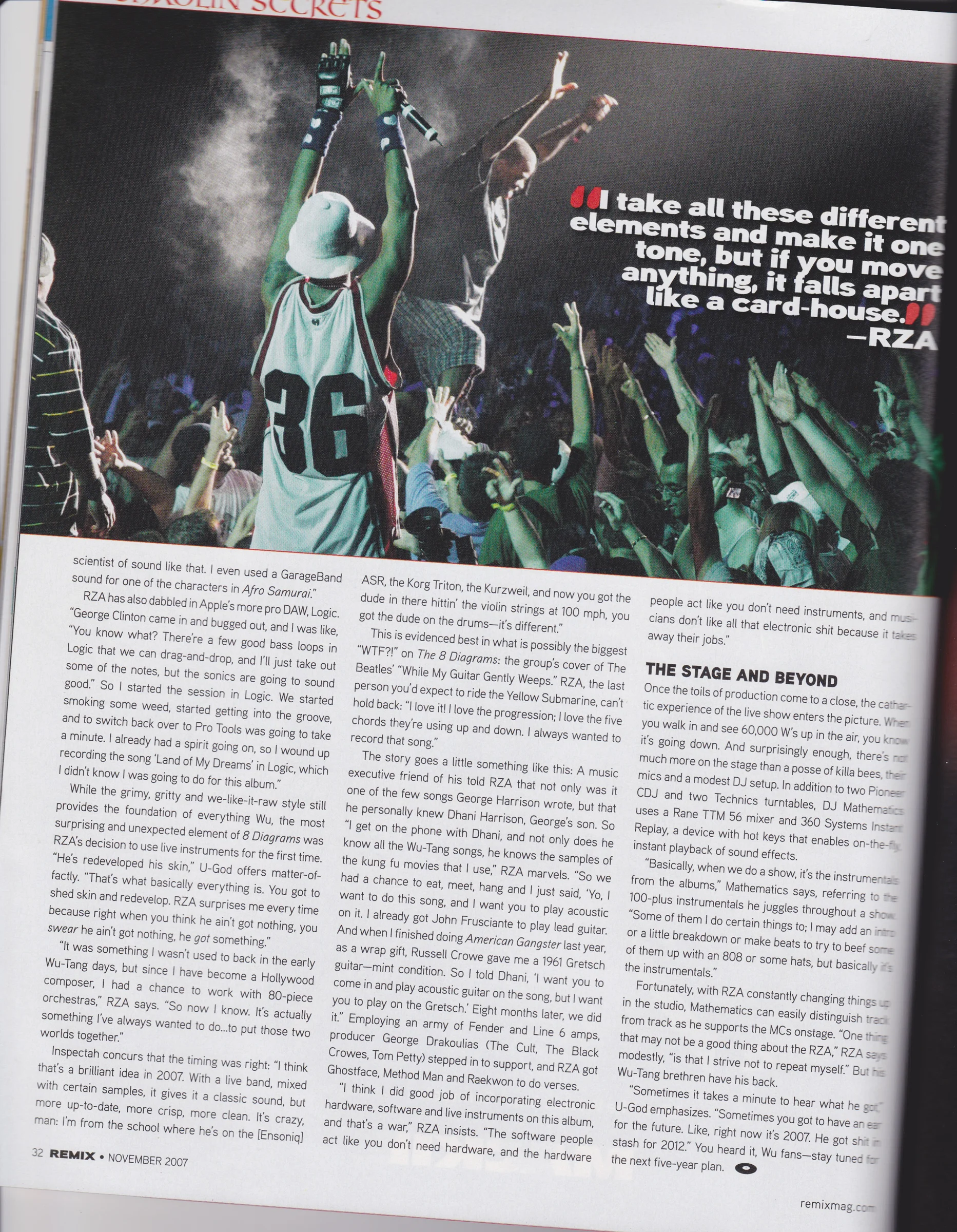
    “Method Man will vouch for this and Tru Masta will vouch, if you come to my studio session, if you touch one fader after I mix everything, you’ll be like ‘that’s not on beat.’ The only thing keeping it on beat is the levels of where everything is at. You got like 15 things making one sound. I take all these different elements and make it one tone, but if you move anything, it falls apart like a card-house.”

    “One thing I do different than a lot of producers is, most producers want their bass to hit with their kick,” RZA demonstrates with an impromptu beatbox, “but I don’t think you need to. The bass can be wherever the fuck it wants to be, as long as it has a space of operation. Sometimes my bass note isn’t even the same key as my kick note. A long time ago I realized music isn’t only a note and a melody and a harmony, it’s also a pulse. Music is pulse.”

    “A lot of people are straight 1, 2, 3, 4, they’re so formatted…they think the snare has to come here. With this dude,” the Inspectah marvels of RZA, “the snare may come in on an off-bar, but when it come in, it come in with a smack. It come in and announce itself. That’s the difference between him and a lot of other producers. That’s why we sound the best when we rhyme with him.”

    Well, that and the methods and lessons learned through 14 years of recording and adjusting to the nuances of 9, and often more, emcees, each with their own subtle quirks requiring different approaches and levels of attention. “In the old days it was more like I knew whose voice would go on which beat, but over time, everyone’s talent has grown and expanded and voices have changed somewhat. In my opinion, no producer ever mixes Ghostface voice the way I mix his voice. I always had his voice more warmer,” RZA confidently presents before explaining. “A vocal only sleeps between 70 and 100 kilohertz. Between that 70 to 100 khz, you got to find that perfect balance for your artist that takes away some of the nasal high, while still keeping the warmth of the mid, and a little bottom.”

    ”Each Clan member had their own compressor, so when they came to my house or studio, their compressor was always set to their voice. I had a preset channel that I would never touch.” RZA used Avalon and Urei pre-amps, as well as the DBX-160 compressors with Pultec EQs, both of which he rented for The Eight Diagrams as well.

    “Basically, he’s the conductor,” states Inspectah Deck, “so all I got to do is give him what I feel was decent to me, like my vocals, my ad libs, then I let him seal the deal. I know by the time he’s done with it, it’s going to sound how it’s supposed to sound. It’s gonna have that Wu Tang edge. There’s only one RZA.”

    “He’d be like ‘Get the fuck out the booth!’,” U-God reflects. “Next day I’m back in again, ‘Get the fuck out the booth!’ next day I’m back in again, then it got to a point where it was like ‘MOTHERFUCKERRRRRR!!’ I mean, the last time he kicked me out the booth, I done killed the whole booth, slammed the door, boom boom boom! Went home. But he brought it out of me. He made me go back and correct and made me perfect my shit. Now, it ain’t nothing. He made me a beast.”

    It was at this point that RZA shot a judgmentally discerning glare, sizing me up and down, before offering “I don’t know if I want to tell anybody…but I’ll tell you. I’ll tell your magazine only.”

    Aha! A sacred Shaolin secret revealed.

    “I recorded the vocals in 2 to 3 mics at one time.”

    Uh…

    “I put a mic right at the chest, one up close to the throat, and one right in front of them,” he reveals. “It’s a mess for the engineer. You have like 20 tracks of vocals for Raekwon alone, but I wanted to have a new vocal sound. I wanted to be able to catch a niggas chest ambience, his throat ambience, and maybe his nose ambience.”

    For this process, he used Neumann U87s as the main sensor, with AKG C12s and a Shure 55 Unidyne (“the mic that Elvis used to record his shit”) both of whose positions were slightly altered depending on the emcee up to bat.

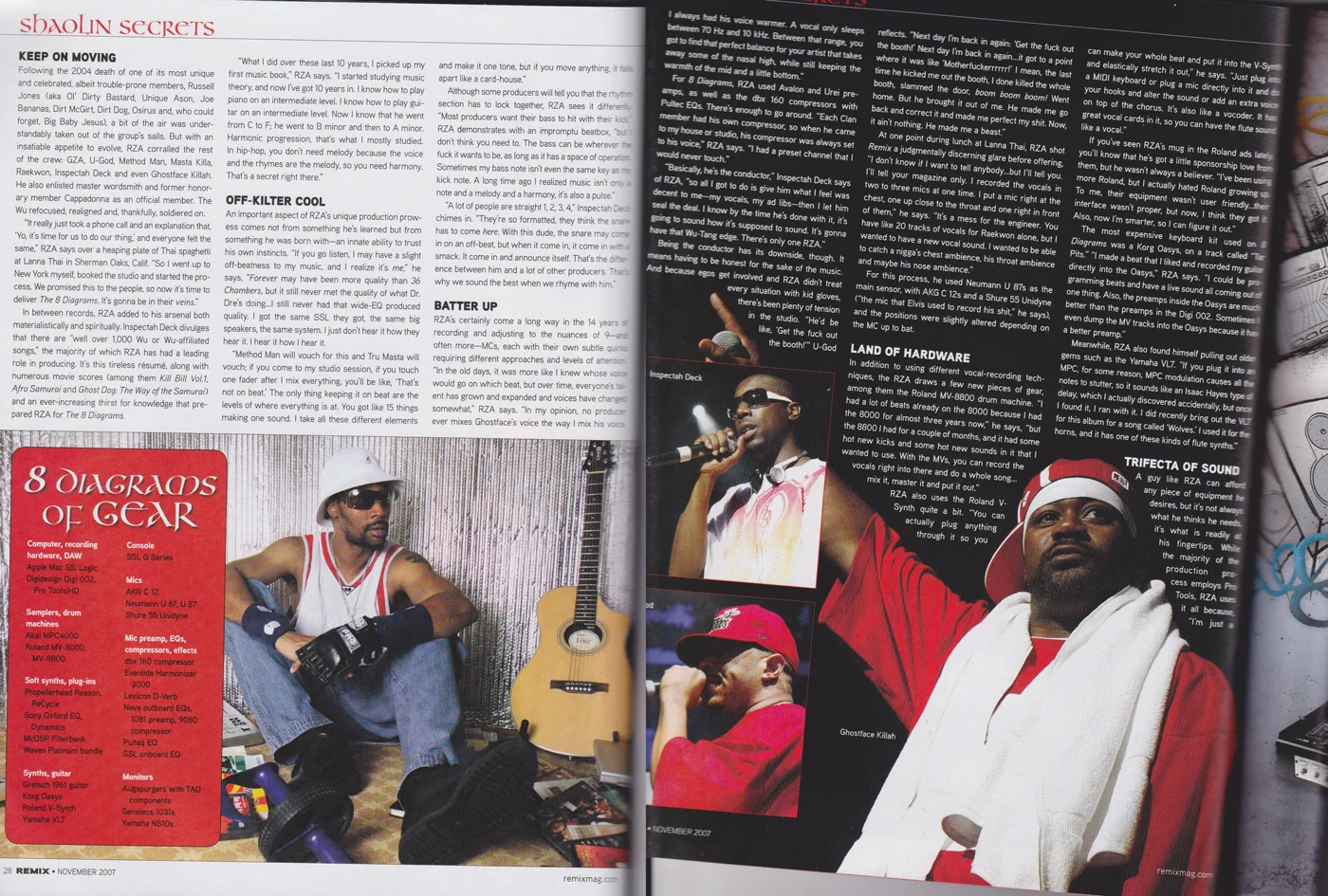
    In addition to utilizing new vocal recording techniques, the RZA draws a few new pieces of gear from his ever-expanding holster. Among them were the Roland MV8000 and MV8800, which he employed for most of the drum beats. “I had a lot of beats already on the 8000 because I had the 8000 for almost 3 years now, but the 8800 I had for a couple of months and it had some hot new kicks and some hot new sounds in it that I wanted to use.” Furthermore, “with the MVs you can record the vocals right into there and do a whole song…mix it, master it and put it out.”

    Other new pieces of gear, such as the Roland V-Synth ”was a surprise. That’s a strange machine. You can actually plug anything through it so you can make your whole beat and put it into the V-Synth and elastically stretch it out and do all kinds of shit. Just plug up to a MIDI keyboard or you can plug a mic directly into it and do your hooks and alter the sound or add an extra voice on top of the chorus. It’s also like a vocoder. It has great vocal cards in it, so you can have the flute sound like a vocal.”

    “I’ve been using more Roland, but I actually hated Roland growing up. To me, their equipment wasn’t user friendly…their interface wasn’t proper, but now, I think they got it. Also now I’m smarter so I can figure it out. There’s even two beats on the album where I use the Roland Oasys keyboard, which is the most expensive keyboard you could buy.”

    “I used the Oasys for a song called ‘Tar Pits’ because the Oasys can give you 16 tracks of MIDI sounds and 16 tracks of audio. So I made a beat that I liked and recorded my guitar directly into the Oasys. I could be programming beats and have a live sound all coming out of one thing. Also, the pre-amps inside the Oasys are much better than the pre-amps in the (Digidesign) Digi 002. Sometimes I even dump the MV tracks into the Oasys because it has a better pre-amp.”

    RZA also found himself pulling out older gems such as the “Yamaha VL7. If you plug it into an MPC, for some reason, MPC modulation causes all the notes to stutter, so it sounds like an Isaac Hayes type of delay, which I actually discovered accidentally, but once I found it, I ran with it. I did recently bring out the VL7 for this album for a song called ‘Wolves.’ I used it for the horns and it has one of these kind of flute synths. Also the (VL7’s) virtual bass sounds real good.”
    Remix-Magazine_Wu-Tang_2007-6

    Granted, a guy like RZA could afford to acquire any piece of equipment he so desires, but it’s not always a matter of what you think you need, it’s a matter of using what you have. While the majority of the production process employs Pro Tools, RZA uses it all because “I’m just a scientist of sound like that. I even used Garageband.”

    Errr…he correctly interprets my blank stare as desire for explanation…

    ”I was on a plane, I was fucked up, I was bored, had my laptop, and it sounded good. I sent it for the Japanese to hear it for one of the characters in Afro Samurai and they were like ‘woah, we like that.’”

    But back to The Eight Diagrams, where RZA found himself unintentionally using Logic. “George Clinton came in and bugged out and I was like, you know what? There’re a few good bass loops in Logic that we can drag and drop and I’ll just take out some of the notes, but the sonics are going to sound good. So I started the session in Logic. We started smoking some weed, started getting into the groove, and to switch back over to Pro Tools was going to take a minute. I already had a spirit going on, so I wind up recording a song in Logic, which I didn’t know I was going to do for this album.”

    “When the Clan heard it, they all loved it, and everybody threw vocals on it. Raekwon said ‘we got no ‘C.R.E.A.M.’ on this album, a song that’s like that soul loop thing that you do’ and that’s what this is, and it’s just one of those songs that I just did because I was fuckin’ around with George Clinton. It’s called ‘Land of My Dreams.’”

    While the grimy, gritty, and fuck-you-up-cuz-we-like-it-raaaaaw still provides the foundation of everything Wu, the most surprising and unexpected element of The Eight Diagrams was RZA’s decision to use live instruments for the first time in the process of producing a Wu Tang Clan album. “He’s redeveloped his skin,” U-God offers matter-of-factly. “That’s what basically everything is. You got to shed skin, and redevelop.”

    “It was something I wasn’t used to back in the early Wu Tang days, but since I have become a Hollywood composer, I had a chance to work with 80 piece orchestras,” RZA gleams. “So now I know. It’s actually something I’ve always wanted to do…to put those two worlds together.”

    “As far as production-wise, RZA is a scientist with what he does,” the Inspectah awes. “I think that’s a brilliant idea in 2007. With a live band, mixed with certain samples, it gives it a classic sound, but more up to date…more crisp…more clean. It’s crazy man, I’m from the school where he’s on the ASR, the Korg Triton, the Kurzweil, so nowadays to be in hip-hop and you got dude in there hittin’ the violin strings 100 mph, you got dude on the drums, it’s different.”

    “He surprises me every time, because right when you think he ain’t got nothing, you swear he ain’t got nothing,” enthuses U-God, “he got something.”

    This is perhaps evidenced best in what is possibly the biggest WTF on The Eight Diagrams…their cover of The Beatles’ “My Guitar Gently Weeps.” RZA, the last person I would have expected to ride the Yellow Submarine, can’t hold back. “I love it! I love the progression, I love the 5 chords they’re using up and down, I love it. I always wanted to record that song.”

    The story goes a little something like this: a music executive friend of his told RZA that not only was it one of the few songs George Harrison wrote, but that he personally knew Danny Harrison, George’s son. So “I get on the phone with Danny and not only does he know all the Wu Tang songs, he knows the samples of the Kung Fu movies that I use,” RZA marvels. “So we had a chance to eat, meet, hang and I just said ‘yo, I want to do this song and I want you to play acoustic on it. I already got John Frusciante to play lead guitar…and when I finished doing American Gangster last year, as a wrap gift, Russell Crowe gave me a 1961 Gretsch guitar…mint condition. So I told Danny this is how we’re going to do it…’I want you to come in and play acoustic guitar on the song, but I want you to play on the Gretsch.’ 8 months later, we did it.”

    Employing an army of Fenders and Line 6 amps, “the recording was supervised by (producer) George Drakoulias (The Cult, The Black Crowes, The Jayhawks, Tom Petty) and I got a verse from from Ghostface Killa, a verse from Method Man, and a verse from Raekwon the Chef.”

    “I think I did good job of incorporating electronic hardware, software, and live instruments on this album, and that’s a war” muses RZA. “The software people acting like you don’t need hardware, hardware acting like you don’t need instruments, and instruments don’t like all that electronic shit because it takes away their jobs.”

    Once the toils of production come to a close, the cathartic experience of the live show enters the picture. When you walk in and see 60,000 ‘W’s’ up in the air, you know some shit’s going down. And surprisingly enough, there’s not much more on the stage than a posse of killa bees, their mics, and a modest DJ setup. In addition to “2 (Pioneer) CDJs, and two (Technics) M3s, I use a Rane 55 mixer,” DJ Mathematics says. “And 360 Systems Instant Replay,” adds RZA, a device with ‘hot keys’ that enable “on-the-fly instant playback of sound effects.”

    “Basically when we do a show, it’s the instrumentals from the albums,” divulges Mathematics. “Some of them I do certain things to, I may add an intro or a little breakdown or make beats to try to beef some of them up with an 808 or some hats, but basically it’s the instrumentals.” Over 100 of them spanning 6 albums (and that’s just the Wu as a whole…doesn’t even include the several hundred Wu-affiliated tracks RZA rightfully takes credit for).

    “One thing that may not be a good thing about the RZA,” RZA humbles, “is that I strive not to repeat myself.”

    “Sometimes it takes a minute to hear what he got, sometimes you got to have an ear for the future,” U-God emphasizes. “Like right now it’s 2007. He got shit in stash for 2012.”

    Uh-oh…bling-bangers “You best protect ya neck!” Are we witnessing the eerily familiar beginnings of another 5 year plan…

    (Parts of this were originally published in Remix Magazine in 2007. Couldn’t find a copy of it anywhere anymore, figured I’d post it here so it exists in the interwebs. Click here for a PDF of the printed article. The videos were part of a Kotori Magazine interview we did with them as well.)
  • Danger Mouse Gets Hammered At UCLA

    Danger Mouse Gets Hammered At UCLA

    danger mouse
    danger mouse

    (Note: This was originally published in Kotori Magazine in 2008)
    The first real internet generation is all growz up. They find themselves at a point where society has no choice but to accept what they have to offer.

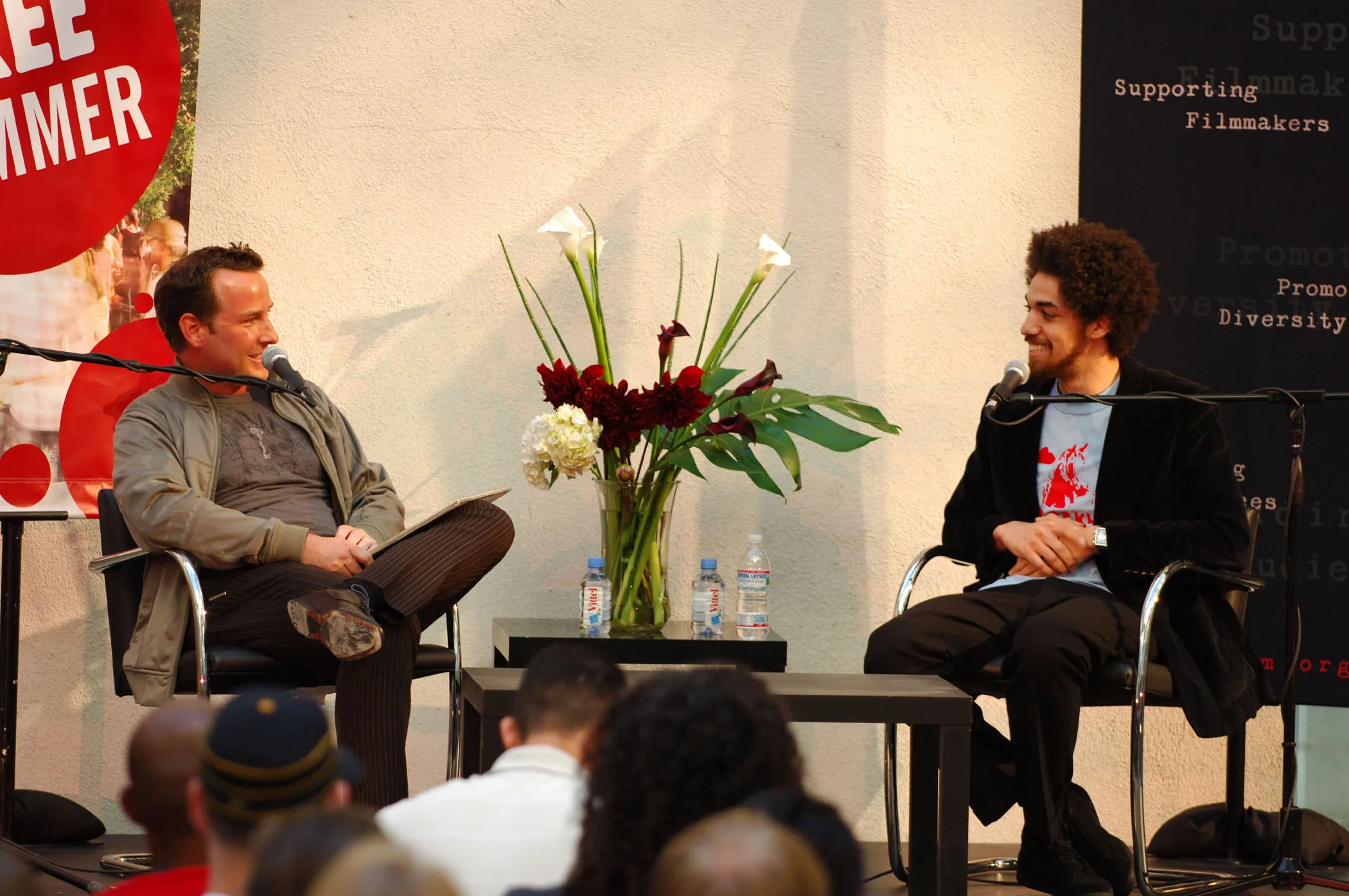
    UCLA’s Hammer Museum finds itself in a position to merge popular culture with aspects of the global subculture in such a way that presents both of them as indispensible parts of each other. They’ve tapped into this age of edge by truly ‘seeking’ out quality rather than simply ‘settling’ for what we’re commonly given. To find such notable aspects of our future culture, one has no choice but to cut up the cookie cutter and relish in the surprising satisfaction that comes with the process of discovery.

    Dig into the underground.

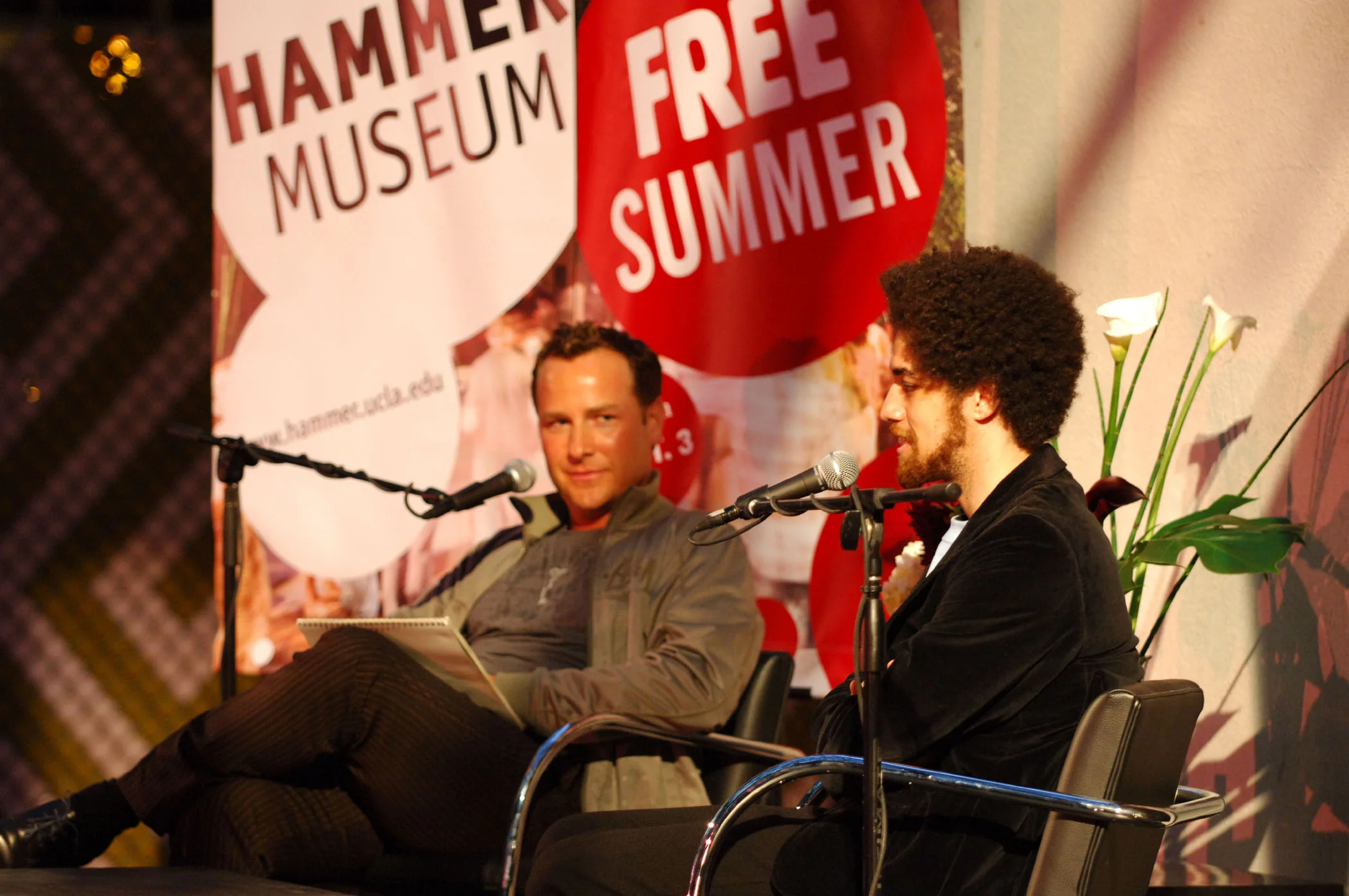
    With their Conversations at the Hammer Museum series, which take place in the museum’s airy and sunny courtyard, the museum’s goal is to ‘pair creative thinkers from a range of disciplines for engaging provocative discussions of culture, science, and the arts.’ Furthermore, ‘the conversations are meant to be organic and spontaneous.’

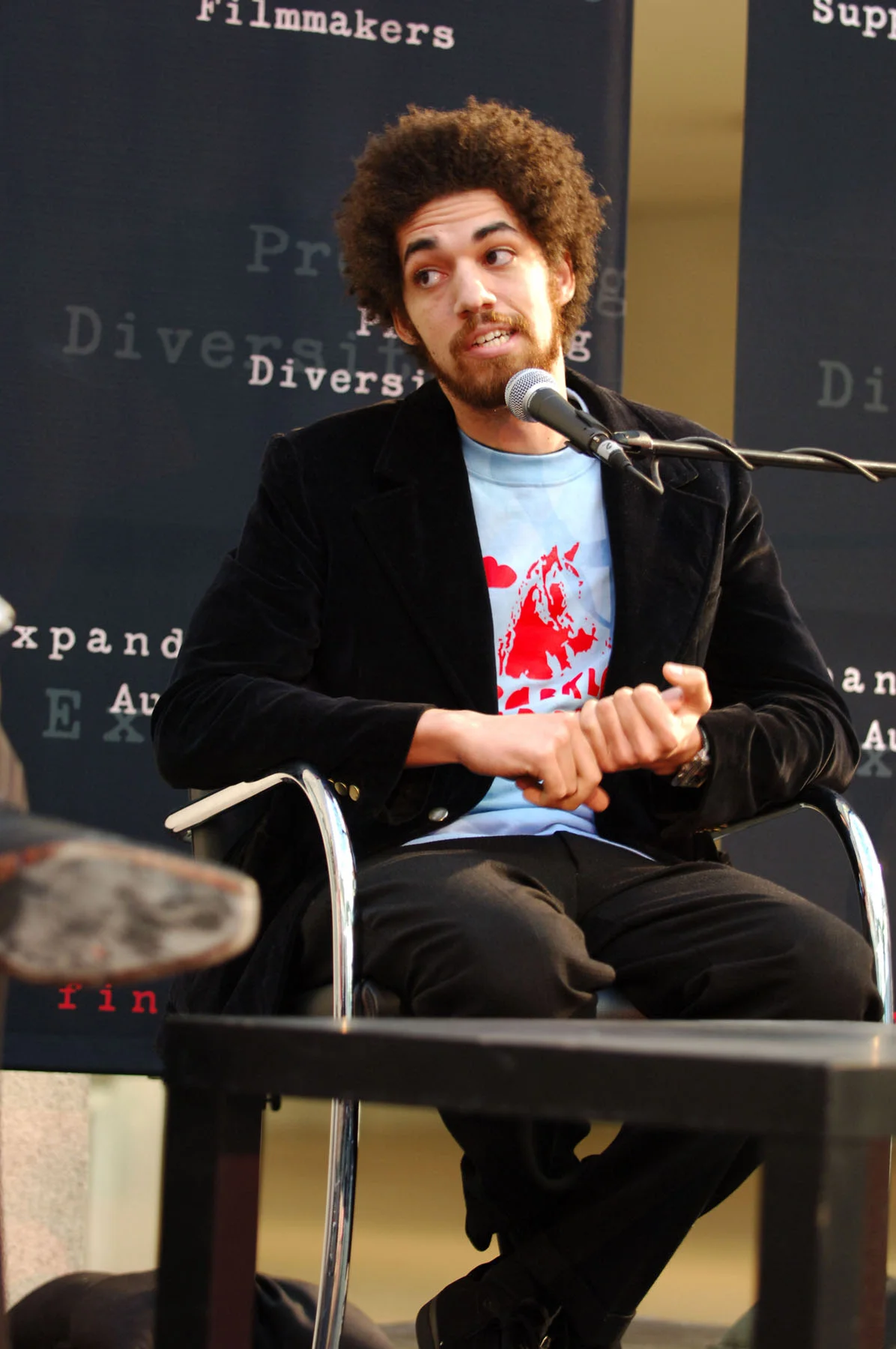
    Judging from their first session…they’re onto something here. Who better to usher in the series than Brian Burton and Jason Bentley, two men who have benefited quite tremendously from the globalization of information?

    Brian Burton is best known as DJ Danger Mouse. He’s the guy who, just two years ago, mixed together Jay-Z’s Black Album and The Beatles’ White Album into The Grey Album. This not only garnered unprecedented attention from fans, but more importantly from those who despised what he did…copyright attorneys. To their dismay and surprise, it all helped cement his position as a personified ‘hero’ and today one of the most sought after producers in the hip-hop world.

    danger.mouse.0102_Small
    danger.mouse.0102_Small

    Since then, he has been nominated for a Grammy for his production work on The Gorillaz’s Demon Days, has further proved his eccentric tastes by joining legendary emcee MF Doom in last year’s Danger Doom, and most recently, has lit up the global charts with his work with former Goodie Mobster Cee-Lo in this year’s insanely acclaimed Gnarls Barkley. Mention the track “Crazy” to 10 people and you’ll get 12 favorable responses.

    He joins founder of Quango Records and KCRW and KROQ DJ Jason Bentley (who has also served as music supervisor for countless films including The Matrix) in this fine summer afternoon conversation covering everything from music to film to cartoons and beyond.

    www.hammer.ucla.edu
    www.dangermousesite.com

    (This was originally published in Kotori Magazine, a print magazine I founded and ran in the mid-2000s)

    danger.mouse.0263_Small
    danger.mouse.0263_Small
  • The Greg Palast Solution : Kill the Rich!

    The Greg Palast Solution : Kill the Rich!

    (This was originally published in Kotori Magazine, a print magazine I founded and ran in a previous life)

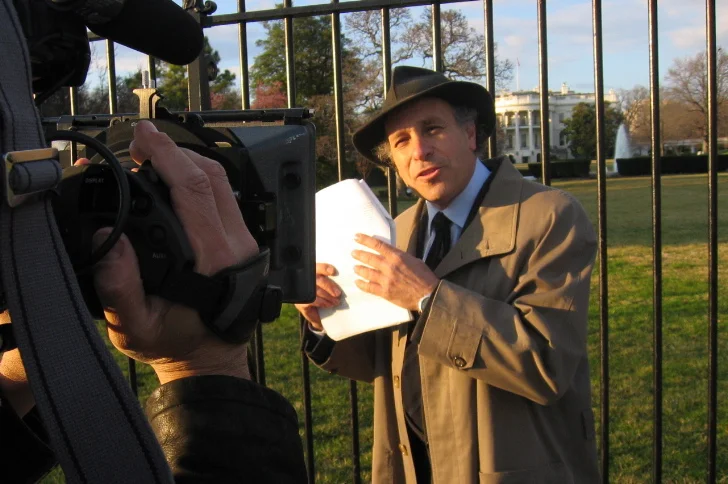
    Guantanamo’s Orange Suit City is America’s 8th largest metropolis, we have 11,000 TV stations all programmed by Rupert Murdoch’s wired brain preserves, and President Jeb Bush is buddy buddy with President bin Laden of Eurasia. This is Greg Palast’s report from the future.

    Greg Palast
    Greg Palast

    Far fetched? Maybe. But after reading Greg Palast’s latest better-be-bestseller Armed Madhouse, it’s hard to think anything other than ‘we could only be so lucky.’ The facts and details and reports that he offers are so much more disturbing than the scenario described above, it’s sure to make you wonder why we don’t all just get our tubes tied and pipes smashed before clocking out of work today. Yet, as vile as the contents may be, this is undoubtedly one of the most important books of our time. If we were truly focused on liberty and justice for all, this would become required reading in our nation’s classrooms. But it’s not. And it never will be. It’s too depressing. In other words…it’s too honest. “Considering the stories I have in Armed Madhouse, if it was all done in a serious grim style, you wouldn’t make it without Valium,” Palast confesses. Damn good thing he has a sense of humor.

    Sure, you can write him off as a “conspiracy freak maniac weirdo pinko,” but the fact of the matter stands, he’s a ‘maniac’ that has won more distinguished journalism awards and accolades than he can find room for in his cramped NY office, and a ‘freak’ who has been one of the most coveted correspondents for some of the world’s largest and most esteemed news outlets, including Harper’s, the BBC, The Guardian, and The Observer. Yah, many of those are British outlets, but really…would any domestic mainstream news outlet be stupid enough to print any sort of stories that might provoke a bit of thought? Their families need to eat for cryin’ out loud (not to mention those darned Lexus payments)! But that still didn’t stop his last book, The Best Democracy Money Can Buy from popping up on the New York Time’s bestseller list.

    Not only that, but he’s a ‘weirdo’ that has earned enough respect to warrant the attention of some of our country’s highest level individuals from the world’s highest level institutions. Among those from where he magically manages to acquire a seemingly continuous stream of dizzying inside information are the World Bank, the FBI, the State Department, ExxonMobile, and the Pentagon. “A lot of reporters won’t take it. It’s a lot of hard work to go through this stuff, verify shit, figure out what a lot of it means,” Palast tells us, “but I will. Stuff marked Top Secret…Confidential…I LOVE that stuff.”

    This brings up a couple of important ethical points. One…there is actually someone out there willing to do the work that their job description calls for: investigate. Two, people truly exist…from within the system itself, who believe it imperative enough to make certain incriminating information public that they are willing to risk their careers, and in many cases, their lives. “For personal decisions or moral reasons, they put themselves in the line of fire. But I’m telling anyone that wants to hand me documents, I’ll go to prison before I give you up. Like the shit I get from inside the World Bank, it’s fantastic shit!! But if any of those people got caught, their careers are toast, so I would never give them up.

    “What we have in America is ‘silly news’ which is done in this weird serious solemn style…we’re telling you fluffy bullshit about the President…he’s at his ranch, he’s just a regular guy, he just fell off his bike…whereas I’ll do some funny offbeat crap about some really heavy serious stuff about Iraq. It’s also more fun for me, because I would otherwise go insane,” Greg explains. “If you talk to people in weird language about anti-imperialism and stuff like that…if you use that kind of twisted language…well, two things are going to happen…you’re not going to convince anyone, and you’re not going to get laid.” Sold me.

    Palast may be the only person in the world to claim that “I had two writing teachers…Charles Bukowski and Allen Ginsburg” after studying finance under free-trade luminary Milton Friedman. “I didn’t go to journalism school,” he confesses. “That’s probably why my brain isn’t fuckin’ twisted in a pretzeled bullshit careerist knot.” His work only validates that point.

    He was the first to break the Bush voting scandal of 2000 and describe in horrifying detail their methods (and no, it wasn’t faulty voting machines), and he was the guy that snuck his way into Tony Blair’s inner circle, exposing him to his biggest scandal, “Lobbygate.” Now, among other things, Palast is the first to report the story of the voting scandal of 2008…but wait…that hasn’t happened yet…or has it?

    With Armed Madhouse, Palast comes at us armed with information from within the very establishments he criticizes. In addition to the proof that the 2008 election is already fixed, and the names and circumstances of those responsible for drowning New Orleans, Palast has acquired both of Bush’s plans to seize Iraq’s oil (yes, both). Surprisingly enough, it wasn’t so they can sell it…quite the contrary. The reports reveal that we went into Iraq “to make sure we don’t get the oil. The oil companies love it. They’re getting 70 bucks a barrel. 3 bucks a gallon. That’s mission accomplished. I mean, if we’re chanting down the street ‘no blood for oil’, most Americans think that’s a bargain…blood for oil.” Makes sense in a disturbing way doesn’t it?!

    In our A.D.D. society that has turned to 15 second ‘news’ reports centering more on how large the reporter’s rack is or splashy motion graphics that flash ‘HOT’ where one would normally expect a fahrenheit figure, Palast remains one of the few still willing to put himself in harms way to gather and expose real and relevant truth. “Look, we’re made stupid,” he shouts. “All this shit about ‘they’re coming to get us’…if it’s not the Muslim hordes, it’s the Mexicans crawling over the border to get us. It’s this whole thing to make us afraid, and when you’re afraid, you get stupid.”

    But if you’re like me, at this point, you don’t want to hear anymore about what is happening. You don’t want to see anymore about the depressing huntas and corporate regimes that control our lives and our futures without a single breathe of our consideration. You’re tired of hearing about the corruption and the scandal. And the exponentially growing front in the class war? Fuggedabit! What you (well, at least I) want to know is, is there anything we can do about it? So that is precisely how I approached him on a recent evening in Manhattan. His immediate response?

    “Well, there are simple solutions like ‘kill the rich.’”

    Uhh…

    “But really, we haven’t been doing too bad. Did you expect Cheney to come out of his bunker with his hands up saying ‘you got me’ so we can read him his rights? And I mean, yah, Bush stole the election, but that means he didn’t win. Score one for the American people,” he explains matter of factly.

    “The question is…are people going to un-stupid themselves? I think there are signs of it. We start out with the ability to do a few things,” he continues. “We can organize, we can march…”

    At that very point, his wife walks in, inquiring about putting their children to bed, prompting him to add “we can have lots of babies so they can’t get rid of us!”

    It’s this very demeanor and presentation that has made him so effective. The sarcasm, the wit, the humor.

    “Listen.” He gets serious. “Every action that’s worth a shit starts at the fringe. It starts off as marginal, then it becomes the center. Even when frickin’ Nixon was President, you got this shit scheming little bastard and he still passes the Environmental Protection Agency law, the Occupational Safety and Health law…there was a lot of progressive action that happened.”

    “New Orleans should have been our rallying cry. Why didn’t people march and gather there by the thousands? For the most part people were like ‘oh well, we lost a city,’” Palast laments. “We should NEVER LET THAT GO…that a government can let a city drown…bodies floating in the streets…that city was drowning long before the levees ever broke…economically. 1927 is when the entire American political system changed, when the levees broke in New Orleans. The nation was horrified. At the time, the local Public Service Commissioner, Huey Long, rose up and said ‘screw this…these rich guys are drowning us!’ He literally began a revolution, then he became governor of Louisiana, and then Roosevelt picked up the line as the New Deal.”

    “You have to bring the war home to people, the concepts home to people. All I know is that suddenly you hit people’s points…their kid has cerebral palsy and they have no goddamn health insurance…and someone asks ‘why is that?’ No matter what we say, we still had 59 million people that voted for this guy. They didn’t care that they didn’t have health insurance, he just told them he’d make sure boys don’t kiss boys and that we can have the 10 commandments at the courthouse door.”

    “You’ve got to vote, just like you have to wipe your ass. It’s just a part of life. Don’t let them take that away from you. They can steal some of the votes some of the time, and all of the votes some of the time, but they can’t steal all of the votes all of the time. If you’re a black person, you’ve got about a 1 in 7 chance that if your ballot will not count. Does that mean you don’t vote? No, that means, you better get your brother to vote too! For God’s sakes, fuckin’ vote! If you can’t do something that dipshit simple, then take the Che Guevara poster off the wall, get rid of the fashion statement, and just bag it. Do the basics man!”

    “One way to bust through the electronic Berlin wall is through music. I mean, to me it’s pretty significant that my stuff’s been introduced in spoken word form by Jello Biafra, that Eminem did a video, ‘Mosh,’ that was inspired…whatever the hell that means…by my work. So they can tape my mouth and keep me off Fox, but they can’t take me off the dance floor. That’s no shit important!”

    “Use the music and the full concept of the counter culture,” he passionately continues. “Not everything has to be political. You buck the system by creating music they don’t understand, by having clothes and language they don’t understand, by not taking shit-dumb-stupid-brain-dead-fuck-up jobs that destroy you and eat your life and then you’re dead. You don’t want their music that’s picked out by Sony and EMI. You don’t want the food that’s been packaged for you by McDonald’s. You don’t want the movies that they have chosen for you. You don’t want your job as a way of thinking, or the candidate they have chosen for you. I think it’s a question of total resistance from morning til’ night on all fronts cultural and political.”

    He stops and looks out the window upon 2nd Avenue for a brief moment. A touch of nostalgia glimmers in his eyes. He begins fondly reminiscing about his days as a working class child growing up in Los Angeles’ San Fernando Valley. “We were the loser class,” he softly utters. “We were ready to be shipped off to ‘Nam. And here were these people playing this weird guy with a weird voice…Bob Dylan. I remember his first album.”

    He smiles.

    “That’s when it started busting apart.”

    He pauses.

    “But remember, it was all fringe shit until it became mainstream.”

    Here is where our interview session began to draw to a comfortable close. Duty called. Our future was in his hands and he had to attend to it. In this case, it took the form of twin 9 year olds.

    Before I turned to walk out, I couldn’t help but chuckle to myself as his dog ran off with his wife’s shoe, and he went chasing after it. The genius mind behind some of the world’s most important information is human after all..

    …and so are we.

    (This was originally published in Kotori Magazine, a print magazine I founded and ran in the mid-2000s)

  • The Prodigy : What Evil Lurks In The Hearts Of Men?

    The Prodigy : What Evil Lurks In The Hearts Of Men?

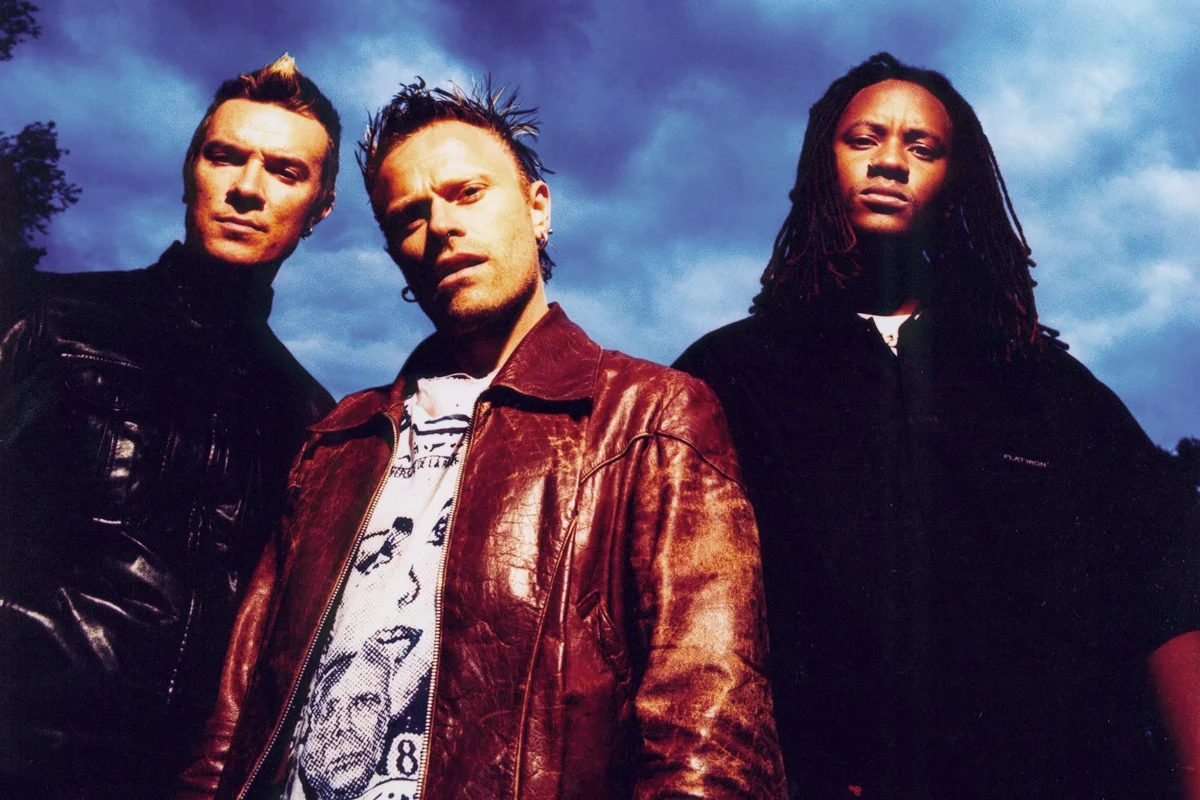
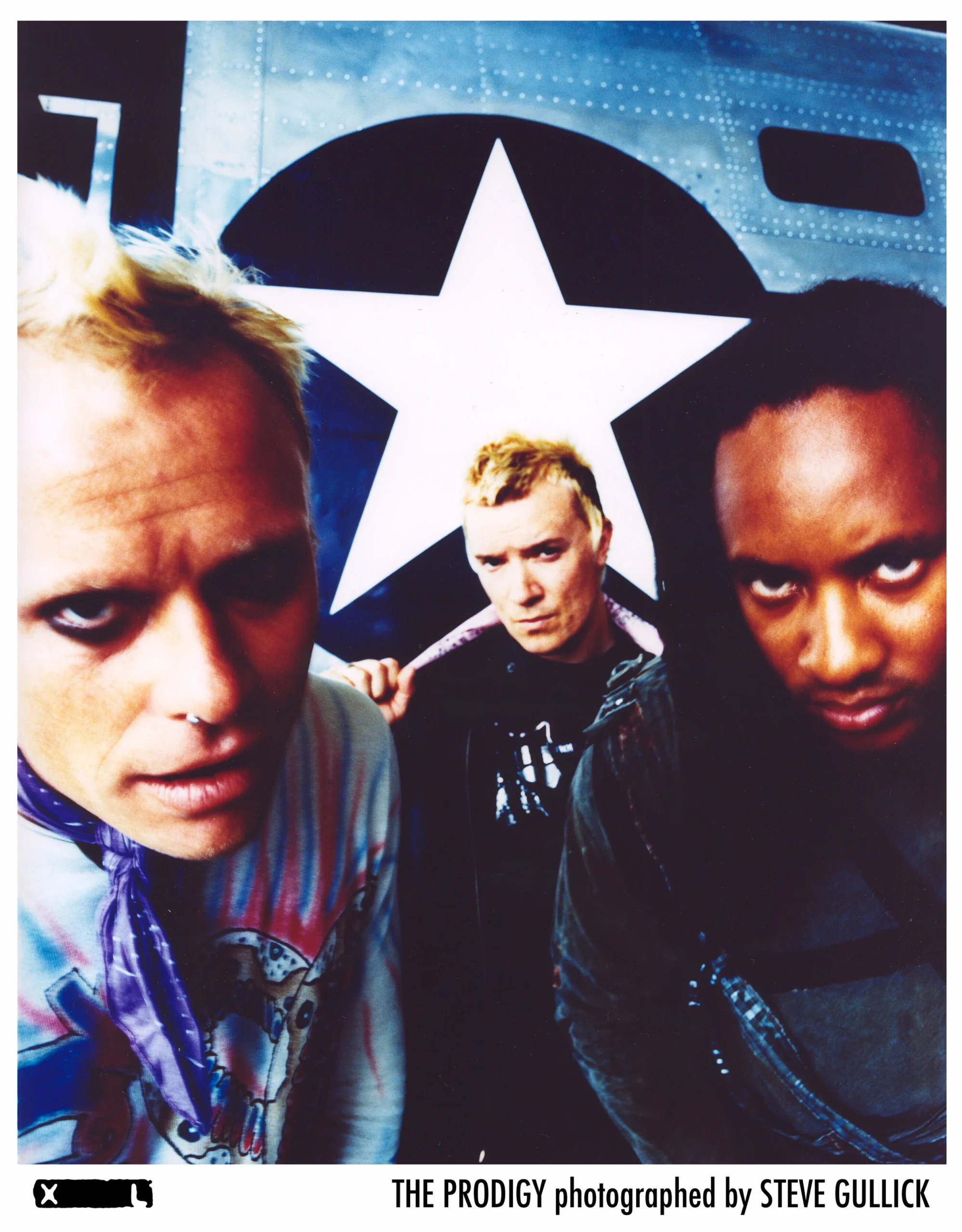
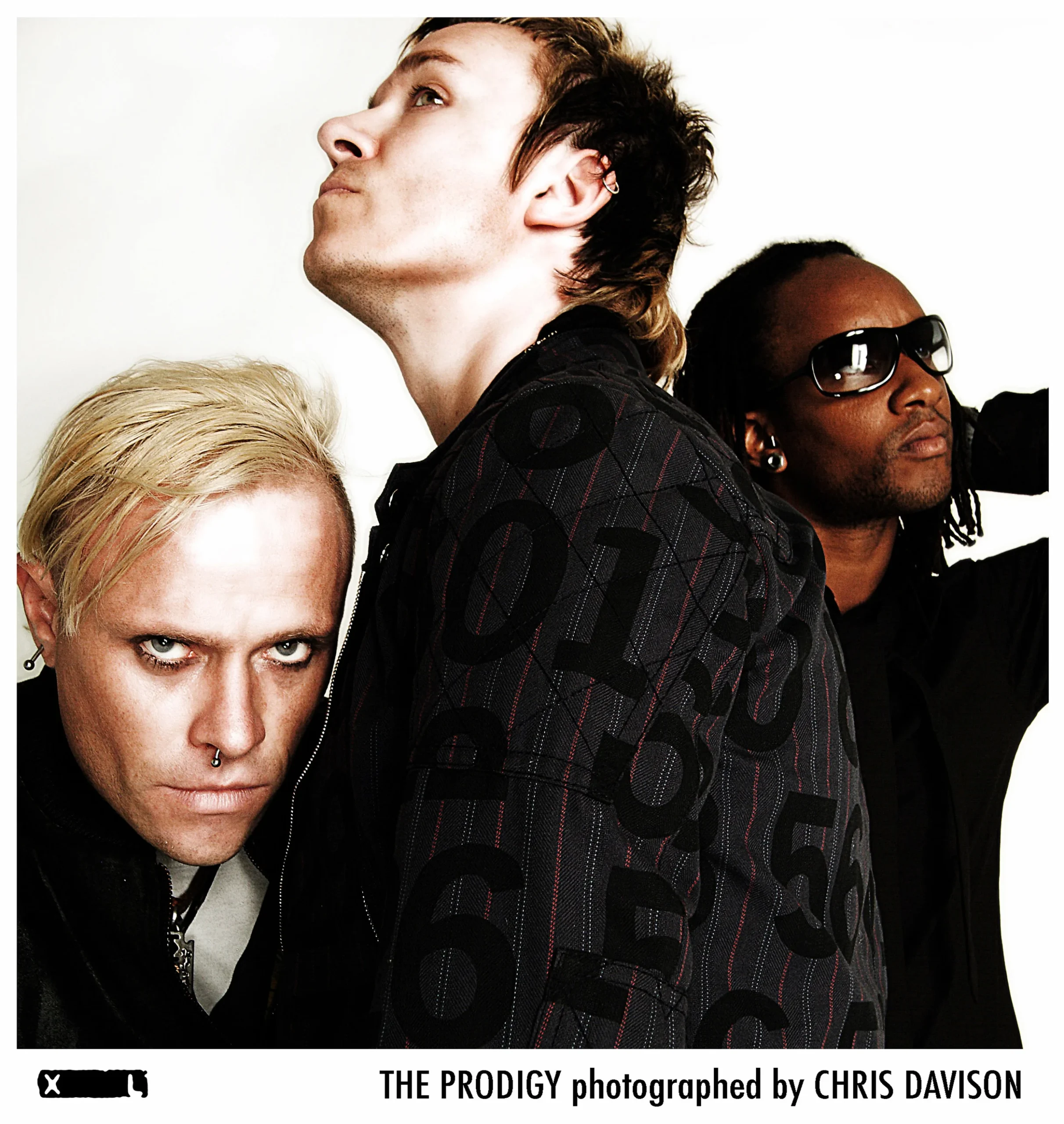
    prodigy
    prodigy

    “For me, being on stage…that is my release…that is my buzz…that is my drive…that is how I raise my adrenaline…how I get my blood flowing!” -Maxim

    The Prodigy are on a mission. An expertly strategized and skillfully manipulated mission to resurrect the freak flag and catapult crowds into frenzy, it’s still their time, it’s Their Law.

    Following the nauseating barrage of hip-shit bling-hop that finally began its demise over the past couple of years, 2006 witnesses an overdue lull in our diluted pop and mainstream music worlds. In the midst of this atrocious period of the stale and easily forgettable, it’s always safe to navigate the underground. The underground is where people are not afraid to experiment. It’s where ‘safe’ is frowned upon and innovation fields its essence. It’s where labels like Definitive Jux, Quannum, Up Above, and Rhymesayers, and acts such as Danger Doom, Aesop Rock, Lyrics Born, and Ohmegga Watts helped rejuvenate much needed credibility and the re-emergence of hip-hop as a genuine reflection of culture, a true art form.

    It’s 2006 ya’ll, the timing couldn’t be better for an electronic renaissance. It’s been years since the rave-bubble popped, people have emerged from their haze, tossed the binkies, and they’re realizing that everything towards the end of that era pretty much sucked ass! By that point, it really wuz the drugs. Now we…uh… they’ve had a chance to refresh and remind themselves of the joys of discerning quality in sound over psychosomatic Qualudes.

    People are rightfully searching for something new and fresh, and the technologies from the old school analog world and the new school digital plane are beginning to align into a comfortable duality of creative and unconstrained evolution. While both sides have struggled to understand where the other fits, others have decided to simply seize the moment and show people why and how we can all be one big happy family. Well, maybe not everybody.

    With their aggressive punk rock regalia blanketed in thrashingly poetic synth-lines and gritty, dirty, rumbling low-ends, The Prodigy have taken it upon themselves to remind people what it’s like to freak the fuck out and be emotionally jarred by sonic aural frequency radiation…yes…music. Fortunately for us, they’ve chosen this year to do it.

    “It started when we all met on stage,” reminisces Maxim. “That was the first show The Prodigy ever did. I met everyone like 3 hours before the show. We had a drink, we looked at each other and said, ‘OK, so how are we going to do this?’ I just got on stage and freestyled and the crowd loved it.” With Keith’s screeching prowess, Maxim spittin’ verse, and Liam droppin’ bunker-bustin’ break-beats, they left a far-reaching impression. The promoter wanted them back right away, and soon after, huge parties such as Raindance and Perception were asking them to play. “It was a buzz just to play on stage at these events, and we really haven’t looked back since.”

    prodigy_mb_7166
    prodigy_mb_7166

    Ever since that fateful day over 15 years ago, The Prodigy have released 4 full-length records, on top of too many singles to count, 12 of which consecutively broke the top 20. They had the #1 album in 27 different countries at the same time with 1997’s Fat of the Land, and they’ve toured the world more times than the space shuttle. “When you’re in it, you don’t really think about it, you’re just really enjoying it and doing it. Every year is a bonus,” reminisces Liam. “That’s the mentality right when we first started.”

    The single most important factor contributing to their success was their rowdy and rambunctious live show. “The trouble is a lot of electronic bands wanted to hide behind the equipment,” expresses Liam. “A lot of it revolves around a couple of guys around keyboards.” “We wanted to represent our music and we wanted people to know who The Prodigy were,” adds Maxim. “You can actually see and feel the experience of The Prodigy rather than just listen. Without that energy and that focus of being a live band, there wouldn’t really be a Prodigy.”

    “It’s also what the music stirs up in us,” Maxim continues. “It’s not only representing the music, but the music stirs something up in us and we perform that and people in the crowd watching us appreciate that. We’re doing what the music tells us to do and we express ourselves and we’re not afraid to do that…we thrive on that. That’s what we love. Creating that energy and that vibe.”

    It’s an energy defined by intricately placed live instrumental riffs lined over psychotic break-beats and bass bombs tipping the Richter. You can feel the very vibrations of the marrow in your bones rhythmically pulsating deep in your cerebral membrane like a jackhammer on speed. Samples and vocal spits so cunningly placed into frequencies that coat your eardrums they send the nervous system into a state of temporary euphoric dementia.

    If you’ve ever seen The Prodigy live, you know I speak of self-evident truths.

    And their punk rock theatrics aren’t just a show. They extend well into their uniquely genuine off-stage personas as well. I mean really, how else can you turn down not one, not two, but three of music’s biggest legends for remix work and somehow make it sound so reasonably justifiable? Madonna who? “I had a lot of respect for her, but I didn’t think she should just be able to use me to help her own music when she didn’t really mean anything to me,” Liam says of The Material Girl. “And the same with David Bowie and U2, I made the decision not to do that stuff because I’m not really work for hire. I’m really into my band, my thing, and I don’t want to give other people our sounds.”

    prodi_live_pr2_300d_051004
    prodi_live_pr2_300d_051004

    Their quick rise during the glory days of the early electronic scene in Europe was infectious. It wasn’t long before they were being pushed around the globe, and the States finally decided to pick up on them. It was right around 1997’s Fat of the Land record, which included such classics as “Firestarter,” “Breathe,” and “Smack My Bitch Up.” “I think it hit at the right time,” explains Liam. “It was kind of a new thing, they were pushing the electronic movement and MTV jumped on it.” With a perfect cocktail blend of electronica and hip-hop, they did a remarkable job in uniquely complementing the era’s often unfounded infatuation with the rock/hip-hop hybrid.

    Then, the inevitable began to rear its ugly head. After Fat of the Land, the band began to feel the pressure of the fame and the sales from the label end. They felt that their creativity and the band’s soul were at stake. “We were having to go into the studio because the record company wanted us to make a record,” Liam tells us, “and I wasn’t really into the stuff I was doing. Nothing really gelled.”

    “It was a tough time for the band,” adds Maxim. “We were playing a lot of shows and needed new material. We were on the verge of being burnt out. If I go onstage and I’m not performing 110%, I’m not happy, and the others are the same way. We weren’t really firing 100%, and if tracks aren’t really firing, and the direction’s not right, we’re not going to do it. I think it was summer of 2002 that we decided to take a break…take a step back and look at where we can go in the future.”

    “I wanted some time off,” admits Liam. “Maybe my time off was a bit too long for other people and maybe other people started to develop solo projects. Then when I was ready and wanted to get going, there was a big communication breakdown between me and Keith. That can breed paranoia, and after months, that gets bigger and bigger and sometimes you see a problem that wasn’t even there. That was definitely the case with a few things.” After a ridiculously solid 12 year run, it seemed the world was on the verge of losing them.

    Liam tried to fill the voids with 1999’s mostly uninspired The Dirtchamber Sessions, Volume 1 mix record, and 2004’s lukewarmly received Always Outnumbered, Never Outgunned, in which, despite even this tumultuous period in The Prodigy’s career, Madonna still couldn’t stay away and signed them to her Maverick records. Vocal duties were handled by various guests including Kool Keith, Liam Gallagher, and Juliette Lewis. “I think a lot of people were confused by that record. Even though it had a couple songs that were classic Prodigy, without Maxim and Keith’s vocals, I think it felt like less of a band.

    This period of uninspired dissatisfaction spurred them to refocus on what they were in this thing for in the first place. “As soon as I got back into the swing of things and we started communicating again, everything was alright,” remembers Liam. “There was a lot of talking in hotel rooms at 3 in the morning over the last year to discuss with each other different issues and talk about all the things that went on. That was healthy. It worked. And we came out of it mates again. That’s what matters.”

    prodi_singl_pr4_300d_131005
    prodi_singl_pr4_300d_131005

    That’s also what led Prodigy to reflect upon what they have accomplished. It’s also what led them to regroup with a renewed vigor they haven’t felt since Fat of the Land. “We still feel like we have a lot more to give. We’re not finished. The band’s not over,” an enthused Maxim reiterates. “This band is going for the rebirth and I tell you man, we’re just fired up! We all ignite at the same time and that’s what its all about.”

    After being inundated with regressive musical tangents, innumerable production advancements, and the soul sucking world of barcodes, The Prodigy has finally had a chance to sort things out and bring it back to basics – making music that moves themselves as well as the masses.

    “When I did Fat of the Land, I had a studio full of gear and could get my hands on anything. It just got too much. I think I’ve come full circle by not getting swallowed up in technology. I just set up a new studio in London and tried to keep it really simple – a couple of keyboards, a guitar amp, and a computer. The approach now is that these are the 3 members of the band. These are the people we’re going to work with. The record will be basically written by these three members.”

    Consequently, 2006 sees The Prodigy’s most actively inspired year in over half a decade. While the new record is currently being recorded, before its release early next year, they will have scoured America from West to East Coast and all the go-betweens, including the cementing of their legendary status with a rare live appearance headlining the Ultra Music Festival at this years Winter Music Conference in Florida.

    Additionally, they tease us with Their Law: The Singles 1990-2005 (XL Recordings). “When we did this album, it was the first time we really sat down and looked at what we’ve done,” expresses Liam, “and we’re proud.” In addition to a full color 50 page booklet, the double CD set includes 31 tracks of their biggest singles, live tracks, remixes, and 3 new songs.

    Their Law, for us…is how we conduct ourselves, how we go about doing things…we stick by those rules and regulations and ethics. One thing we found was that there’s a newfound energy being on the road. Energy is created and vibes and ideas are born. There’re all these ideas starting to breed and flow and we realized what we missed.”

    “It’s what’s good about all of us,” Maxim continues. “We’re quite diverse in the styles of music we like, but the common ground is the energy it creates. That’s what brings us together. There’s a good feeling just being back.”

    theprodigy.com

    (This was originally published in Kotori Magazine, a print magazine I founded and ran in the mid-2000s)